
How Its Made
It starts with a mould
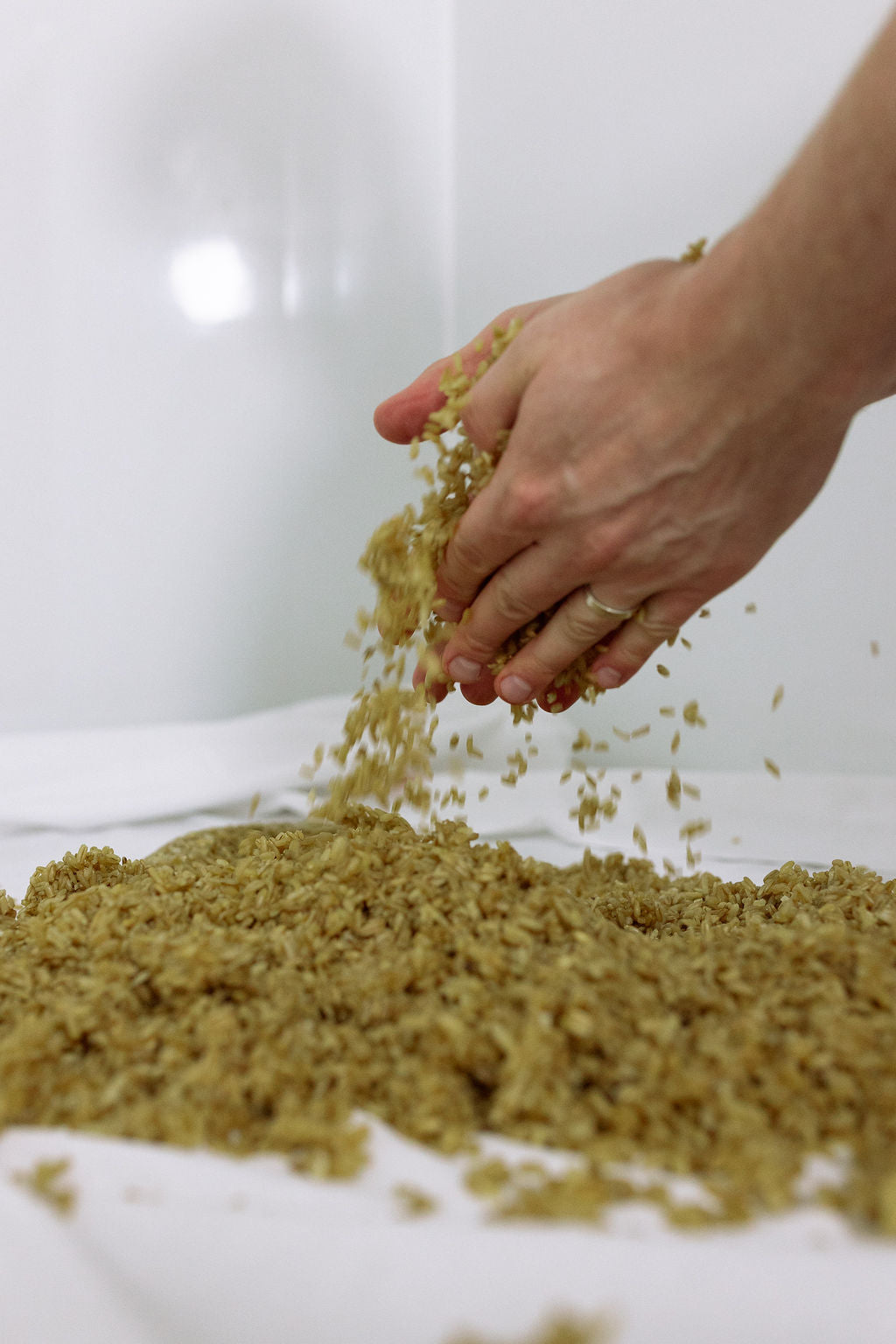
Every jar of Slow Sauce starts the same way: with koji. It's grain, oats in our case, inoculated with a mould called Aspergillus oryzae, and it's the quiet engine behind more or less every great Japanese ferment you've heard of: miso, soy sauce, saké, mirin, all of it.
Koji works by producing enzymes that break down starches and proteins into sugars, amino acids and flavour compounds. That's the science bit. The short version is simpler: koji is what turns something plain into something deeply savoury.
It's not a one-off trick either. Koji is one branch of a much bigger mould-fermentation family that runs right across Asia, from Chinese doubanjiang to Korean gochujang. We're just the Scottish branch of it.
.jpg?v=118392240673899669201787564560)
Not Japanese miso. Scottish miso.
We're not trying to out-Japan Japan. Traditional miso leans on soybeans and rice, and nobody does that better than the people who've been doing it for centuries. We've got huge respect for that tradition. It's the whole reason we're here.
What we're doing instead is asking a different question: what does koji fermentation look like when you use what's actually growing around you? In Aberdeenshire, that's oats, one of the great grains of this part of the world, and Carlin and Flamingo peas, heritage pulses with a deep, savoury character and a real link to British food history.
Same method, same logic: koji, salt, time and microbes. Different ingredients, different place. Japanese miso will always be Japanese miso. This is our version of the craft, not a copy of theirs. (We'll get properly into the oats and peas themselves another time. This page is about the process.)
.jpg?v=85301706049078782831787564577)
The oat ferments
Our oat component goes in first: koji, salt, water, oats, then we leave it alone for around three months while the enzymes get on with their slow, unglamorous work, breaking things down and building flavour up.
.jpg?v=143041293373196402521787564568)
The pea ferments
The pea component takes the long road: roughly a year, aged slow in oak. Peas ferment at a different pace to oats, so we let them take exactly as long as they need rather than forcing them to keep up.
.jpg?v=47292608356380395221787564564)
Time and microbes do the work
This isn't a marketing line, it's genuinely the method. We're not rushing fermentation along with shortcuts or additives. Once the oat and pea components are ready, the flavour that ends up in your jar has been built entirely by time, salt and whatever the microbes decided to do with it along the way.
.jpg?v=87535178389513187081787564558)
Pasteurised, not undone
Pasteurising stops the microbes. It doesn't stop what they've already done. Across those months of fermentation, they've broken proteins and carbohydrates down into amino acids, organic acids, peptides and a range of other compounds, often called postbiotics. Those stay in the jar. That's where the deep savouriness comes from, and it's still there after heating.
Pasteurising is also what makes the jar shelf-stable: happy sitting in a shop, a kitchen or your cupboard, rather than needing refrigeration from day one. Stopping live cultures doesn't stop the flavour they built along the way.
Heat-treating fermented sauces isn't new either. Japanese shoyu makers have used a version of it, known as hiire, for centuries, tracing back to at least the early 1700s. We're borrowing from a very old idea.
